
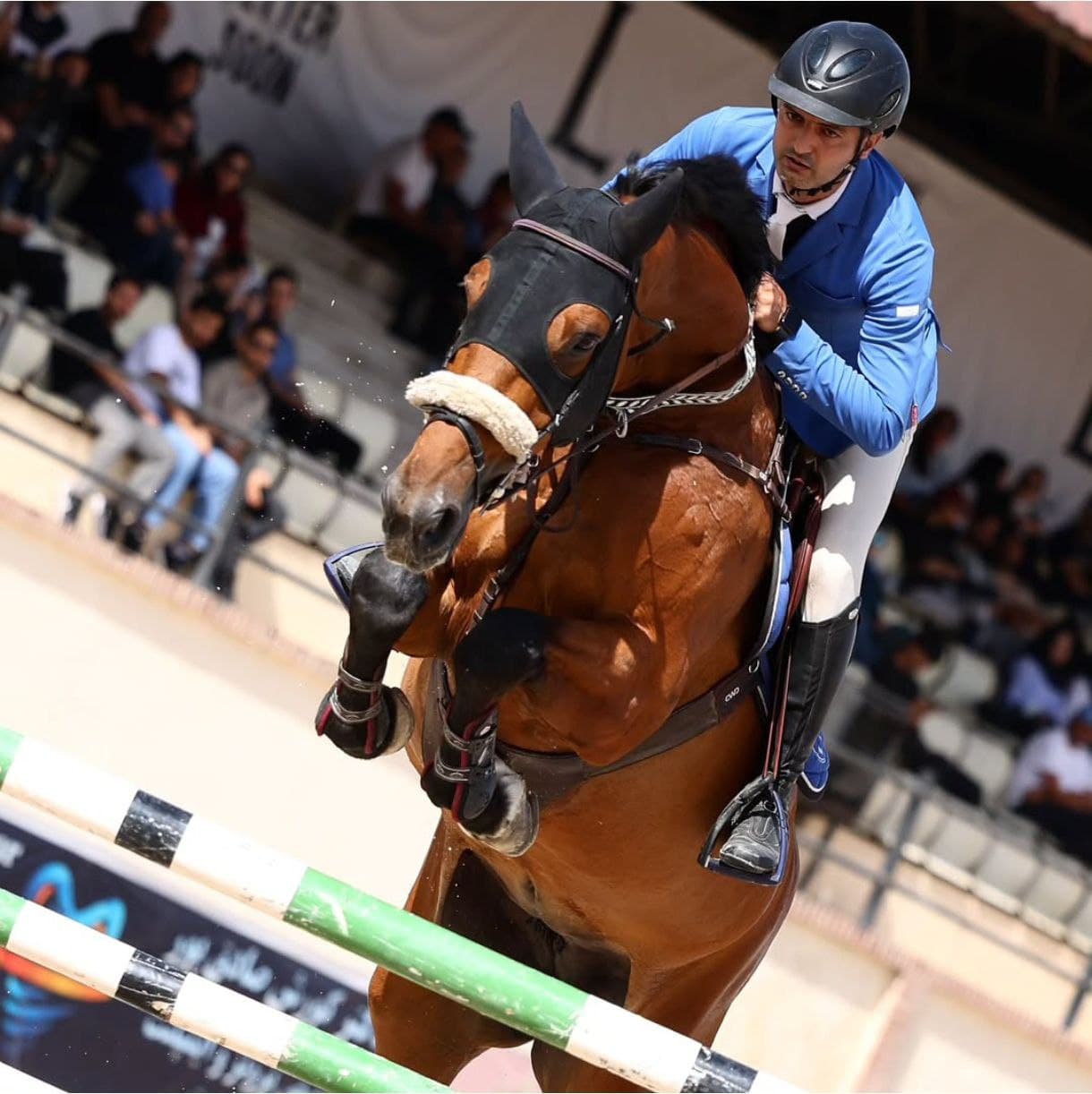
Amore
When the Limitation Is Physiology, Not Potential
The Question
"This horse is genuinely nervous. Jumping her at 145 cm would be madness."
That was the consensus. That was the label.
Amore was a competent athlete at 110 to 125 cm. She was energetic, had good jumping form, and showed genuine ability. But at higher training intensities, she became reactive, resistant, and difficult to work with.
Her owner believed the potential existed. What she didn't know was whether Amore's body could actually build that potential, or whether the behavioral signals meant this horse had reached her ceiling.
The core question was specific:
Is Amore's nervousness a character trait?
Or is it a signal that her physiology isn't ready for the intensity being demanded?
The Assessment
Before designing any training program, we needed to understand what was actually missing.
What the History Showed
Amore had been trained at moderate intensities for years without major issue. But whenever training intensity increased, behavioral resistance increased alongside it.
Her owner recognized this as a pattern, not a one-time event.
What the Testing Revealed
Over three weeks of comprehensive physiological assessment, covering exercise response testing, heart rate patterns, blood lactate behavior, glucose metabolism, and recovery characteristics, a striking finding emerged:
Amore's aerobic capacity was underdeveloped relative to her jumping demands.
More importantly: her anaerobic capacity was severely underdeveloped.
In testing at higher velocities, lactate response remained consistently low, indicating that her body had not yet built the high-intensity metabolic systems she would need.
The Core Finding: Physiology, Not Character
The problem was not that she was nervous.
The problem was that her body was not built for the intensity she was being asked to produce.
When a horse's physiology cannot efficiently handle a given intensity, resistance is a normal, honest response.
It is not stubbornness. It is the body's feedback that the system is overwhelmed.
Amore wasn't fighting training. She was signaling that her physiology needed development first.
The Intervention
The Strategy: Build Foundation First
The mistake would have been attempting high-intensity work immediately to fix the weak system.
The physiologically sound approach was different:
First build the aerobic foundation that would allow her to tolerate and recover from the training needed to develop anaerobic capacity.
This takes time. But it is efficient.
Foundation → Tolerance → Capacity → Readiness → Performance
Training Progression
Over six months, training systematically built aerobic capacity first, then progressively introduced higher-intensity work.
Key phases:
- Months 1 to 3: aerobic foundation development, controlled progression, adequate recovery.
- Months 3 to 6: transitional phase, systematic introduction of higher-intensity workload, measured escalation based on physiological response.
Each progression was determined by adaptation, not calendar.
The trainer adjusted workload based on daily observation. ZERO•ONE provided the physiological direction and confirmed the adaptation was occurring.
Nutrition: Support for Progressive Development
Strategy was integrated with training progression:
- Stable energy availability.
- Recovery support.
- Micronutrient support for metabolic efficiency.
- Magnesium and B-complex for neuromuscular function.
- Amino acid support for tissue adaptation.
Monitoring: Confirming Adaptation
Testing was repeated at six months to confirm Amore's physiology had actually adapted in the intended direction, not just that her behavior had improved.
What the Data Showed
Aerobic Development
- Heart rate response at standardized velocities improved.
- Recovery rate accelerated.
- Aerobic metabolism became more efficient.
Anaerobic Development
- Lactate response at higher velocities increased, meaning better recruitment of the high-intensity systems.
- Anaerobic threshold shifted progressively higher.
- Performance at challenging intensities improved.
Overall Physiology
- From underdeveloped dual systems to functional capacity in both aerobic and anaerobic pathways.
- From reactive under load to stable response to increasing intensity.
The Result
Performance at Six Months and Beyond
At approximately six months, Amore was jumping at 145 to 150 cm heights in training.
Within one year, Amore was competing at 145 to 150 cm.
The horse labeled as unsuitable for 145 cm was now competing at exactly that height, with clear rounds.
What Actually Changed
It wasn't that Amore's character improved.
It was that her body finally had the capacity to handle what was being asked.
Without resistance from an overwhelmed physiology, the behavioral symptoms resolved naturally.
The Trainer's Insight
After approximately 18 months working with this approach, Amore's trainer reflected:
At first, I didn't understand what the physiological data was supposed to help with. But after a while, I was the one pushing harder than the owner to continue on this path.
ZERO•ONE provided direction. The trainer executed it. Amore proved the potential was there.
What This Case Teaches
Principle: Potential and Readiness Are Different
A horse may have genuine athletic potential and still not be physiologically ready to express it.
Labels often describe current state, not final capacity.
Principle: Capacity Is Built, Not Discovered
Physiological capacity is constructed through systematic training.
It is revealed through data, but only the athlete builds it.
Principle: Build Foundation First
When multiple systems are underdeveloped, building the foundation first is more efficient than attempting to fix the weakest system while the foundation remains inadequate.
Principle: Behavior Signals Physiology
What appears as a behavioral problem often reflects physiological unreadiness.
Training that builds capacity naturally resolves the behavioral symptom.
Clinical Context
This case represents a single athlete over 12 months, with formal assessment at baseline and at six months.
Progression was individual to Amore and contingent on physiological response, not fixed to a calendar.
The Takeaway
The question wasn't whether Amore had potential. The question was whether her physiology could be built to express it.
The label, "this horse is nervous", described her current state under demand.
It did not determine her future.
Once training systematically built what was missing, the athlete proved the potential was there all along.
Sometimes the limitation is not ability.
It is readiness.